
Blog

Read through my latest blog posts and feel free to comment on them if you like.


Filter:

Latest Posts

Leishmaniasis Fact Sheet

Information for pet owners on the infectious disease Leishmaniasis.

What is Leishmania?

Leishmania is a parasite which causes a disease called Leishmaniasis, Leishmaniasis is a severe disease that can affect dogs and other mammals including humans. The parasite is transmitted to dogs via an insect (sandfly) that is not present in the UK. However, it is present in many countries in Southern and Eastern Europe, and dogs that travel or have lived in these areas are at risk of becoming infected.

What are the symptoms of the disease?

Some dogs have no symptoms for months or years after becoming infected. When they become ill with the disease, they often develop skin lesions and become unwell (they may be depressed, lose weight, drink excessively, etc). Some dogs develop kidney failure. It is possible for infected dogs to become unwell without having any skin lesions.

Can cats develop Leishmaniasis?

Yes, but it is very rare.

If my dog has never been abroad, could he become infected?

Although Leishmaniasis has been diagnosed in non-travelled dogs in the UK, it is extremely rare. We assume that these dogs get infected through other less effective routes (e.g. sexual transmission, blood transfusions or bites from infected dogs – the latter is not proven). Fleas and ticks do not appear to be able to transmit the disease.

How will my vet diagnose Leishmaniasis?

It depends on the presenting signs but it is likely to be through a combination of blood tests and sampling (e.g. samples from the skin, lymph nodes or internal organs).

What is the treatment?

Treatment can vary depending on the clinical presentation. For example, some dogs are infected but asymptomatic and do not always require treatment. However, most dogs will require medication and this is likely to be a combination of two drugs (allopurinol and miltefosine or allopurinol and meglumine antimoniate). Allopurinol in most cases will be continued for a few months until the signs have resolved and blood tests have all returned to normal. Unfortunately, treatment is not curative and the dog will remain persistently infected so relapses are common after stopping medication.

So if they are not cured, should they stay on treatment for life?

No, you need to follow your vet’s advice on this but we do not treat for life as this could induce treatment resistance. They are carefully monitored during and after treatment and the medication re-started when there are early signs of relapse. This may not happen for months or years.

Will my dog die of the disease?

Leishmaniasis is a very serious disease and best avoided at all cost. However, it can be effectively controlled if it is well monitored. Many dogs with the disease live normal, happy lives.

How can I prevent my dog from becoming infected?

Do not take your dog to areas where Leishmania is present! This is the best advice to protect your dog against infection.

However, if this is not possible there are good products to repel sandflies and prevent transmission of the parasite (spot on treatments and collars). Speak to your vet for advice on what would be the best product for your pet. They must be applied correctly and you must follow the instructions on the frequency of application. Avoiding exposure to sandflies (the insects that transmit Leishmania) is the most effective way to prevent infection. Sandflies are more active at dusk – so avoid taking your dog out at this time and keep your dog indoors at night.

Can I vaccinate my dog against Leishmania?

Yes, there are vaccines against this parasite which are licensed to be used in the UK. They reduce the likelihood of your dog developing symptoms if he becomes infected but do not prevent infection itself. The only way to prevent infection is to avoid contact with the sandfly.

We recommend vaccination in dogs that travel to affected areas for long periods of time but they must always be used in combination with a sandfly repellent.

I have heard that people can develop Leishmaniasis and it is a very serious disease in people too. Could I become infected from my dog?

No, you cannot get the disease directly from your dog in the UK as a sandfly is required for transmission of the disease. In addition, once dogs are receiving adequate treatment, they are unlikely to spread the disease even in the presence of the sandfly so the risk is very low.

https://vetspecialists.co.uk/wp-content/uploads/2020/05/Davies-Veterinary-Specialists-Leishmaniasis-Fact-Sheet.pdf


Why Dog Parks Are Unnatural & How To Properly Socialize Your Dog

 
We all know the importance of socializing our dogs but often this is mistaken by the thought of “My dog has to play with as many other dogs as possible”! So most people think the dog park is a great place for socialization.

Trust us, we do think dog parks are a great idea for some dogs and owners but not really for socialization.

In many dog parks we witness dogs with very poor social skills and owners who do not understand or underestimate their dog’s communication.

Dog park discussion aside for now though as there are other important factors when we talk about socialization.

What is a “properly” socialized dog?

People:

A well socialized dog is used to all kinds of people of different shapes and sizes and doesn’t feel the urge to go say hi and jump on everybody. But rather he is simply comfortable mingling between people and is able to ignore them unless somebody is asking for interaction and he is confident enough to do so.

Different Environments:

A well socialized dog is comfortable and confident in different environments such as close to a busy road, a large gathering of people, different surfaces such as gravel or unsteady ground and so on.

Dogs:

A well socialized dog is comfortable around different temperaments of dogs and trusts in his handler that they will protect and guide him to the right decisions no matter what. There fore the dog doesn’t feel the need to react to other dogs in any way, negative or positive. He doesn’t get up and stick his nose deep into every dogs butt he doesn’t know and then tries to force them to “play”. A well socialized dog understands and respects the space and boundaries of other dogs and simply ignores most of other dogs when walking along. He also speaks dog very well and can communicate his wishes in a respectful manner and also will accept the same from another dog.

Back to the dog park...

Why are dog parks unnatural, I thought they are the best thing ever for my dog?

We all know that dogs are not wolfs but there are still some similarities. When you look at an established wolf pack, most of the time the pack consist of close relatives and maybe a couple outsiders that were integrated into the pack for breeding purposes. Wolfs and dogs are both social animals and enjoy interaction with trusted companions.

When you observe street dogs, you will notice that they are usually forming packs to serve a purpose such as hunting. It is however very normal that these packs split up randomly and each dog goes its own way again. New packs might form on a regular basis and split up again, some dogs might stay together longer than others and some might form a bonded pair/small pack.

Even then, dogs do only closely interact (or play) with other dogs they trust and know. It is unnatural to adult dogs to just go and play with another dog they have never met before. The reason for this is simply because dogs that haven’t been a part of the pack are strangers!

Imagine if you were sitting in a café, enjoying a cup of coffee and a stranger walks up to you gives you a hug, possibly a kiss on the cheek, sits down and tells you his life story! A little awkward OR even threatening don’t you think? Why? Because he’s a stranger! On the other hand, if they person would approach you and say “Hi, min name is Randal, would you mind if I have a seat?” he is being polite and you actually have a choice to say yes or no. If you say no, he should respect that and go away and if you say yes and he’s polite, he may sit down and you can slowly get to know each other.

This is how a normal dog interaction should go...polite and slowly getting to know each other.

So in the dog park, when you do think “let’s go and socialize my dog by playing with strange dogs”, you put them into a situation that is kind of awkward for them. Some dogs are happy go lucky and do enjoy those interactions and play fine with everybody but be aware of your own dog’s limitations and who you might meet there.

In my personal observation I find that often times dogs that want to play right away with any given dog, have very poor socialization or dog to dog communication skills and most of the times interact inappropriate and rude.

What is proper dog to dog socialization:

In the “wild” dogs don’t run around like maniacs with each other but rather they just mingle…they just hang out.
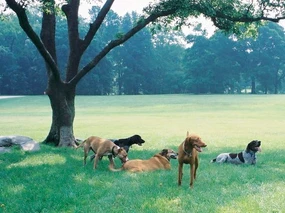
 
You don’t throw a party every time you see your friends, you just like to hang out and maybe have a good chat and a drink. If you do throw a party every time and get drunk, oh well, maybe you are still in your teen stages, just like the adolescent dogs that still have to learn that it is NOT normal ;)

So how can you properly socialize your dog with other dogs in a controlled and structured environment?

Find somebody, a friend or maybe somebody you meet at the dog park and go for on leash walks with your dogs in a neutral environment. No pressure to interact, no play on leash or excitement… just walk together. This is a great way for the dogs to familiarize themselves with each other and get to know each other better. They can sniff the other one by simply walking along with them and get a feel for each other of who they are. Once you have done that with them a few times, maybe let them hang out (no play, just hang out) while you have a coffee.

After a few meetings the dogs know each other, they are not strangers anymore and one might politely encourage the other for a play session. If your dog still seems a little pushy, then it’s on you to teach your dog the right manners and intervene if you do think the other dog might not agree just yet.

Again a well socialized dog is a dog that typically ignores other dogs that don’t belong to his “pack” but is comfortable with polite interactions with strange dogs. He respects their space and boundaries they communicate.

Now we don’t want to keep you from the fun of attending a dog park. Dog parks are often one of the only areas where your dog can be off leash so please grab your dog a ball and enjoy him if you feel your dog is well suited for a dog park. Going to the dog park doesn’t mean your dog has to play with other dogs, he can also just play with you, but be prepared that other dogs might interrupt you and you want to ensure that your dog will be okay with that.

Important is that you choose wisely. Choose a park that is big enough so that you can get away from other dogs if needed and just enjoy the time with your own dog. Also look for a park where you know the people and maybe the other dogs. Get to know everybody and see who you think would be a good play partner for your dog.

Be picky and better be safe than sorry!

If you find somebody suitable, maybe take the dogs for a stroll together so they have a chance to sniff each other first without any pressure of having to interact, let them get to know each other slowly. And once your dogs are comfortable with each other and in fact do like each other, then give them a safe play date where you can control your dog’s behaviour if needed.

 
About the author:

Simone Krebser - CPDT: Owner and head dog trainer of K9 Possible Dog Training serving the Okanagan Valley in British Columbia from Osoyoos to Penticton and Kelowna with result based dog training. Certified dog trainer, certified pet first aid instructor, member of the IACP, dog crazy and chocolate/cheese addict. “My life revolves around dog’s day in and out and I wouldn’t have it any other way. It is my goal to help enhance the lives of as many dogs (and their owners) as possible. Your dog is my priority and I’m as committed to your dog as you are. But I can only help those who sincerely want to help their dogs and not only themselves.”

https://www.k9possible.com/single-post/2016/04/05/Why-Dog-Parks-Are-Unnatural-How-To-Properly-Socialize-Your-Dog?fbclid=IwAR2o4nRYWQ5RqznPnJ-wPuI5A1h7EGQYZeu42JB2FupaIcIRTqLAgxq2Bbg

SalliPets Rescue is a community shelter however our dogs are not kept in  kennels. They live in a beautiful Godstone cottage and are  free roam of the house and gardens.

The house is located on the A22 and we have robust fencing in order to prevent the dogs from getting out. As an extra measure, we have delay gates and procedures in place.

Street dogs are highly capable and intelligent. They can climb, jump and dig their way to freedom and 6ft fences dont stop them. Some have chewed through their chains and escaped and our fences are not an impediment.

Very often we can see in our CCTV camera that they know how to cross the road by waiting for that gap to cross. Luckily, most of them follow our walking routes and they turn away from the A22 and walk along the bridleways we use on our walks.Every one of our rescues has a  Vodaphone tracker thanks to Vodaphone sponsorship.

When our CCTV system alerts us that a dog has breached the perimeter, its time to contact Animal Tracker and doglost.co.uk.

Animal Tracker are immediately responsive and register the dog as lost and communications go out to people in the area to alert them that the dog is lost. We are always thankful for all the support the community provides.


As a community rescue, SalliPets, helps local dogs that are lost. Unfortunately, most Microchip companies don't answer the phone or help us look for the lost pet.

SalliPets then advertises the dog as lost on doglost.co.uk, Drone SAR on Facebook and advertise on local Facebook groups. All the dogs that we have helped, have been found.

We encourage the Pet owner to insure dogs and make sure they choose a responsive Microchip company like Animal Tracker.


https://www.animaltracker.co.uk/


Our rescues are much cherished. When they go home with their new owners, their Microchips are registered with Animal Tracker and insured with Agria.

The Agria free cover lasts 5 weeks and it provides the owners with peace of mind. 


We chose Agria because they pay 97% of their claims. When your pet is ill, you need the Insurance company to pay.

The UK’s Most Trusted Pet Insurance Provider*

GetBigThumbnail.jpg
  • Lifetime pet insurance only, for the very best cover

  • Up to £12,500 every year towards vets’ bills

  • Reassurance that we pay 97% of claims and were awarded ‘Best Claims Service’ in 2019 & 2018

  • Trusted and recommended by over 40,000 breeders, animal rescues and vetshttps://www.agriapet.co.uk/

Separation Anxiety - by Carolyn Menteith

Posted on 7th October, 2021

It seems that the winners of the extra home time we have had since lockdown began are the nation’s dogs. Through the ages, dogs have made such great companions because they are so social - and they transfer their social needs to humans fantastically well.

Few of us are in any doubt that our dogs love us - and for most dogs, having us at home far more is a joy. They can still get their daily walks - maybe more walks than usual - and they have the company of their beloved owners 24/7. As long as they can get the exercise they need, for our dogs, lockdown has seemed a win-win situation.

For those with puppies, this seems like a perfect time to train them, get them used to their new life and begin the bonding process that will last for life. Owners can concentrate on toilet training, playing interactive games, starting to work on training exercises - and just have some relaxing home time building their relationship with their new best friend.

There is, however, one big potential problem. What happens when we return to our regular lives? What happens when dogs who are used to having us around all the time have to spend time home alone?

If we are not careful, we are creating issues that will last long after the lockdown is over. Separation-related behaviour problems (usually referred to as separation anxiety) are one of the hardest behaviour problems to cure or manage - and for a dog who doesn’t have the coping skills to deal with ‘home alone’ time, life can be anything from an occasional misery to a constant state of anxiety and stress that affects their entire life.

Thankfully, it is also one of the easier behaviour problems to prevent.  

Separation-related behaviour problems occur when the dog doesn’t have the coping skills to be on their own or without their owner. This isn’t them being disobedient or punishing their owner for leaving them - it is much more like a human panic attack. Involuntary and highly distressing. Every instinct in their body tells them that being alone is a source of anxiety or fear - because they’ve never been taught that it is “safe” and that it’s just part of the life of a companion dog.

Teaching a dog home-alone coping skills is as much a part of socialisation and habituation as getting them used to all the sights, sounds, scents and experiences that their life will inevitably bring, but it’s a part that owners often neglect in their desire to create a strong bond with their dog.

Whether you have a puppy or an older dog, it is important to spend as much time working on this as you do on your exercise, training and interactive enrichment to ensure that your dog is happy to be alone.

Teaching Home Alone skills

1. The aim of teaching your dog that being on their own is “safe” and even enjoyable, is to make sure that when you do leave them, they have something tasty or fun to do while you are not there. You don’t want them spending their time desperate for you to come back!

2. Start from the very beginning of your life together if you can - so it’s nothing novel or different. If you haven’t already been doing this, start now but start slowly.

3. Small steps… Give your dog their dinner and while they are eating, leave the room for a minute. If you feed them in the kitchen, use a stairgate so you can close that to prevent them following you. They will probably be far too interested in dinner to be worried where you’ve gone but they are slowly learning that good things can happen while you are not there. You can gradually build up the time you are away to take in their entire dinner time - but be aware that a puppy will need to go out to the toilet immediate after they’ve eaten!

4. If you have a secure garden, try scatter-feeding your dog on occasions. Take your dog’s kibble and drop it in the grass for them to hunt out. Once they understand this new feeding game, you can scatter it a bit wider - and leave them for a few minutes while they hunt it out. Again, they are learning that good things can and do happen when you are not there - and they are also using their scavenging, foraging and scenting instincts.

5. You can feed your dog in an interactive toy (like a Kong) - and again, leave them the other side of a stairgate while they work out how to get their food out of the toy - and they will also enjoy the natural chewing and gnawing which is a stress-reliever for most dogs. Start by making the Kong (or whatever safe toy you choose) easy to empty so they easily succeed, and then you can make it harder as they understand how to get dinner. While you are leaving your dog, keep checking in - even if from a distance - to make sure the toy is durable and safe.

6. Don’t let your dog follow you everywhere. While we often like that our dogs need to follow us wherever we go (even to the loo!), it isn’t good for our dogs to think they will always have constant access to us. Use equipment such as stairgates in doorways, which are cheap, easy to fit and they let your dog see where you are going and so not feel abandoned - and they also don’t give them such a fixed physical barrier - and give your dog a treat while you’re gone. The aim is that they look forward to your absences, not worry about them.

7. Once you know your dog is happy being left for a few minutes, you can very slowly build up the length of time you leave them. Don’t do too much too fast. You are teaching them that being alone is safe and nothing to worry about. If you go too quickly, you’ll only teach them that you keep vanishing for ages and it is scary!

8. If you are at all worried that your dog might not be happy when you leave, use a webcam to find out what they are doing when you are not there, and if they show any signs of separation-related behaviours (vocalisation, pacing, panting, salivating, scratching at doors, destruction or chewing, loss of toilet training, inability to eat when alone, aggression (on your return, on leaving, or generally), consult an accredited  behaviour professional with experience in separation anxieties for help. These problems do not go away on their own - and usually get worse!

9. Look on training home alone skills as being as important as toilet training or any other life skill. Your dog is learning from you every minute you are together. Make sure you are teaching them what you really want them to learn for all the years you have together in the future.

*If you are planning a new puppy at any time (especially from any of the breeds prone to separation-related issues - generally toy breeds and those breeds originally developed to work with a strong owner bond), it's important to ask the breeder if they have started teaching the puppies to be happy on their own. 

If you have an Agria Pet Insurance policy, you can access the free Pet Health Helpline, 24 hours a day, 7 days a week. The veterinary-trained team will advise on any concerns or queries that you may have over your pet’s health – much like the NHS 111 service for people. Call free on 03333 32 19 47.  


Why do you need to bring dogs from abroad when we have so many of our own?

This may have been the case in years gone by, but with the advent of the Microchip and Social Media, its become easier to identify a lost/ stolen dog and return it to its rightful owner.

In the last 2 years people have discovered that the cost of acquiring a pedigree puppy has risen suddenly. This is because of supply and demand.

The same can be said of rescue dogs. There is a shortage of rescue dogs and Rescues have started bringing them across from other countries.

Despite the cost of transporting the dog, the vet fees are lower and it makes economic sense to have the dog neutered, vaccinated and microchipped in the country of origin.

What about diseases?

Climate Change is bringing diseases to the United Kingdom that we find in hotter climates. Like most pet illnesses, all the diseases our Vets are unfamiliar with, have a cure or can be managed so a pet can live a great life.


In conclusion I attach the Dog's Trust Survey which highlights the shortage of rescue dogs in the UK.

Dogs Trust Stray Survey


Through the eyes of its stray dogs wandering the streets of Istanbul, Stray explores what it means to live as a being without status or security. As they search for food and shelter, three dogs—Zeytin, Nazar, and Kartal—embark on inconspicuous journeys through Turkish society that allow us an unvarnished portrait of human life. Whether they lead us into decrepit ruins or bustling streets, the gaze of strays act as windows into the overlooked corners of society: women in loveless marriages, protesters without arms, refugees without sanctuary. Through their canine eyes, we are shown a human world ruptured by divisions along class, ethnic, and gender lines. The film is both a critical observation of human civilisation through the unfamiliar gaze of dogs, and a sensory voyage into new ways of seeing and being from a position of extreme marginalisation. It is at this intersection that Stray seeks to shed light on Turkey’s societal convulsions through the observations of Zeytin and her companions —both human and nonhuman.

https://youtu.be/u8iiIbVYPYI

https://www.stray-film.co.uk/#home-section

If you see a homeless dog, would you feed it?

Last Friday night I pulled up to a temporary evening job I’m doing.

In front of my car I see a dog sitting in the bushes. I can see that he’s homeless and afraid.

I approached him real gingerly, lowering myself so as not to appear intimidating and stuck my hand out from a distance, keeping it low.

Within a few seconds he showed himself to be friendly, non aggressive, and lonely.

I took a picture of him, went inside the building, and started asking around about the dog. Several people recognized him and said they had seen him in parts of the city with a high homeless population.

I scoured up some pizza and brought it out to him so he could get some calories back.

The employees at the building were concerned about him and tried to elect someone amongst themselves to “adopt” the dog. We came REAL close with one guy whose dog had recently died, but he called his parents and they would not allow him.

I knew in the back of my mind that if no one agreed to adopt him, then I would have to. I just couldn’t bear the thought of that sweet boy further roaming the streets, suffering malnutrition, cold weather, and possible abuse.

At the end of my shift I loaded him up in my car and a new life began. Uggh. The last thing I wanted or needed was a new dog to take care of, but I figured at the very least, maybe he’d only be with me a day or two before I could get someone online to give him a new home.

He was dirty and smelly, so first stop: the bath.

He had NO idea what that was, and HATED it!

Since it was late at night, it was already bed time and I couldn’t leave him to roam the house or he might chew stuff up or worse. So up in the bed he went, where I could keep my eye on him!

Of course, he scratched and scratched for hours, but FINALLY went to sleep.

Turns out he likes to sleep like a human: with his head up at the pillows and arms outstretched. He took to being a member of the family quite readily.

Long story short: we’re not giving him away now, and Oliver has made himself a place in our family unit, much to the chagrin of our current West Highland Terrier, who is not at all happy about it!

Update:

He is definitely an “on the furniture” type of dog. If you try to take a nap on the couch, he’ll insist on squeezing himself into (or onto) any space available. And our Westie (Finnegan O’Brien) seems to be tolerating him better now. He’s no longer keeping a sourpuss look on his face 24/7. We are working hard towards harmony in the house!

Also, we took him to the vet and he ended up having a microchip. The vet’s office called the “owner” who informed them that he did NOT want the dog back. We also found out his birthday is March 6, 2018.

Latest pic as of 6-5–19

Edit 9-6–19

He's now obsessed with checking the trees for squirrels:

His other pastime, which everyone hates, is “leg wrestling”. If you're sitting down, he comes up to you and grabs one of your legs with both of his. He'll either pull on it, or now he's learned to YANK it! The other day he made me fall right out of my chair! He's hilarious. But nobody can stand his leg wrestling. Except, of course, his proud papa!

11/2/19

12/23/19

He has a giant stick that he likes. He will lay it on his back so he can chew on it:

145.4k views
View 12.8k Upvoters
View Sharers
View 100+ Other Answers to this Question
About the Author